ISF and customs entry filing software
Customs, in focus.
Customs filing software that shows which ISF or entry needs you now. File ISF-10, ISF-5, entry summaries (7501) and cargo release (3461) with CBP from one inbox, check every draft before it goes, and see the ISF price on this website.
20 minutes on your kind of shipments. We set your team up after.

Where filings go wrong
You know these screens.
Most filing teams track house bills in a spreadsheet, file from a vendor screen and read CBP messages in email. The filing that's due tomorrow is in there somewhere. Meanwhile the rules keep moving and the ISF deadline stays exactly where it was.
- in liquidated damages per ISF violation. On a consolidation, each house bill counts.
- $5,000
- Source: CBP, ISF FAQ 2.0 (May 2023) (opens in a new tab); Great Lakes Customs Law (opens in a new tab)
- trade liquidated-damages cases, FY2024 to FY2025. All trade LDs, not ISF only.
- 22,399 → 53,052
- Source: CBP trade statistics (opens in a new tab)
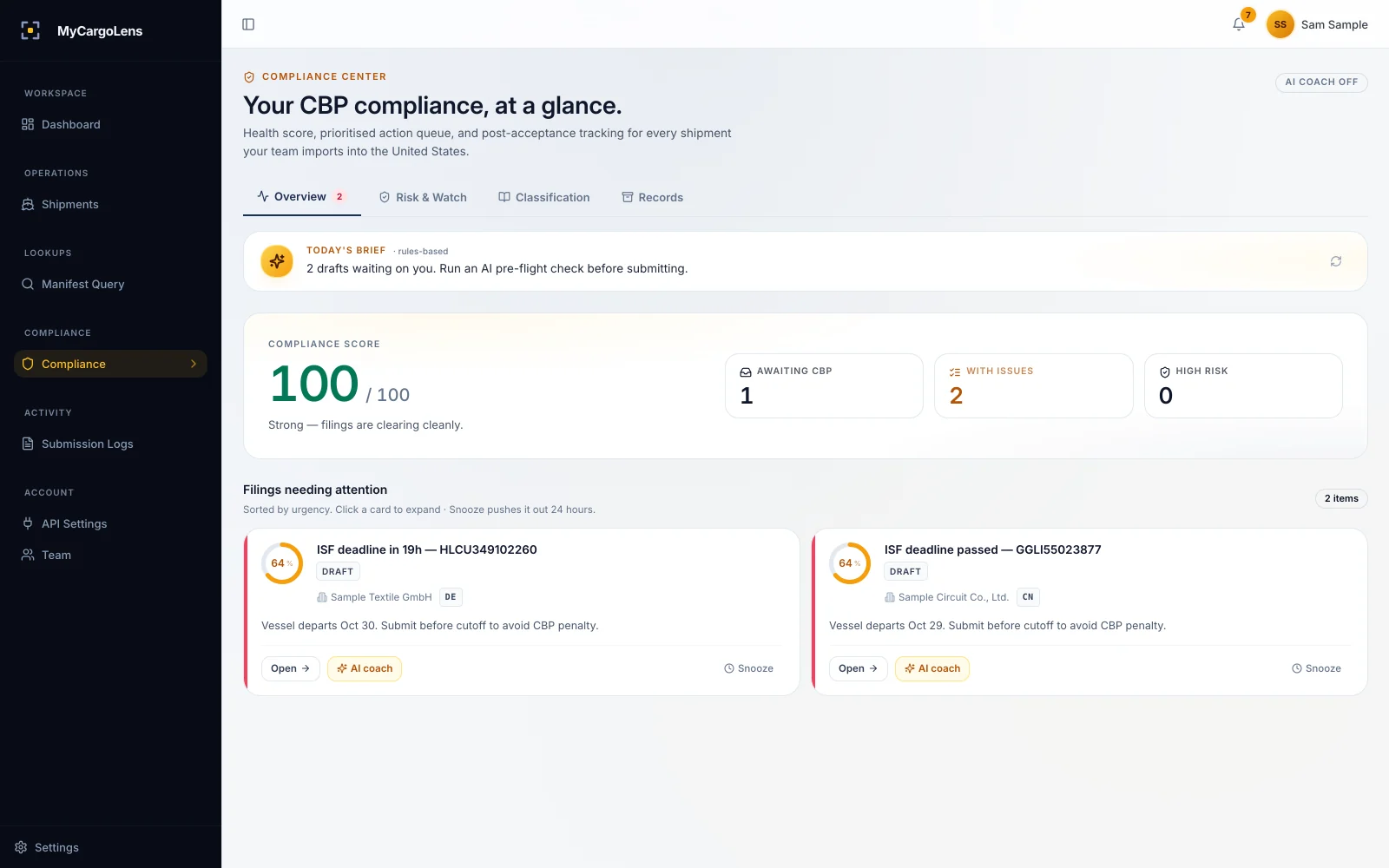
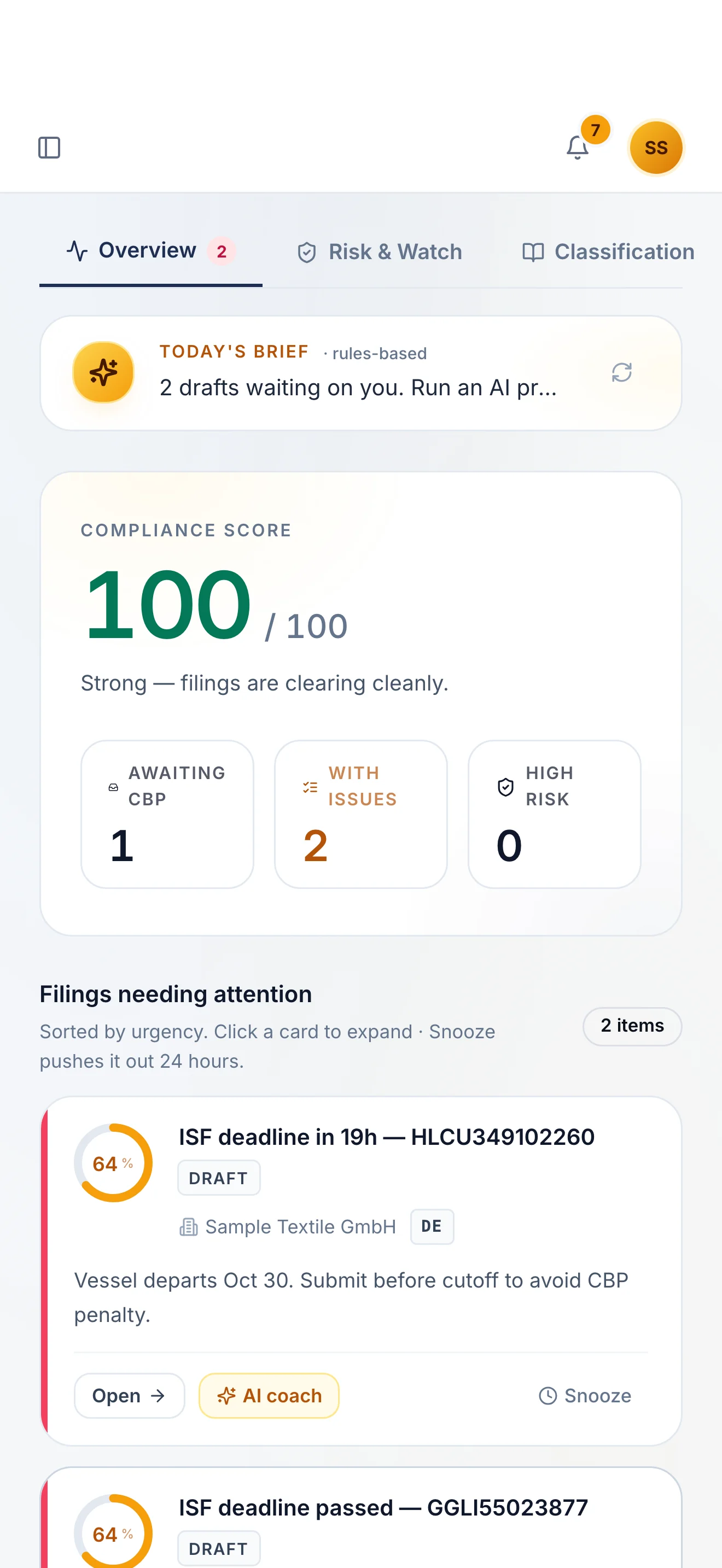
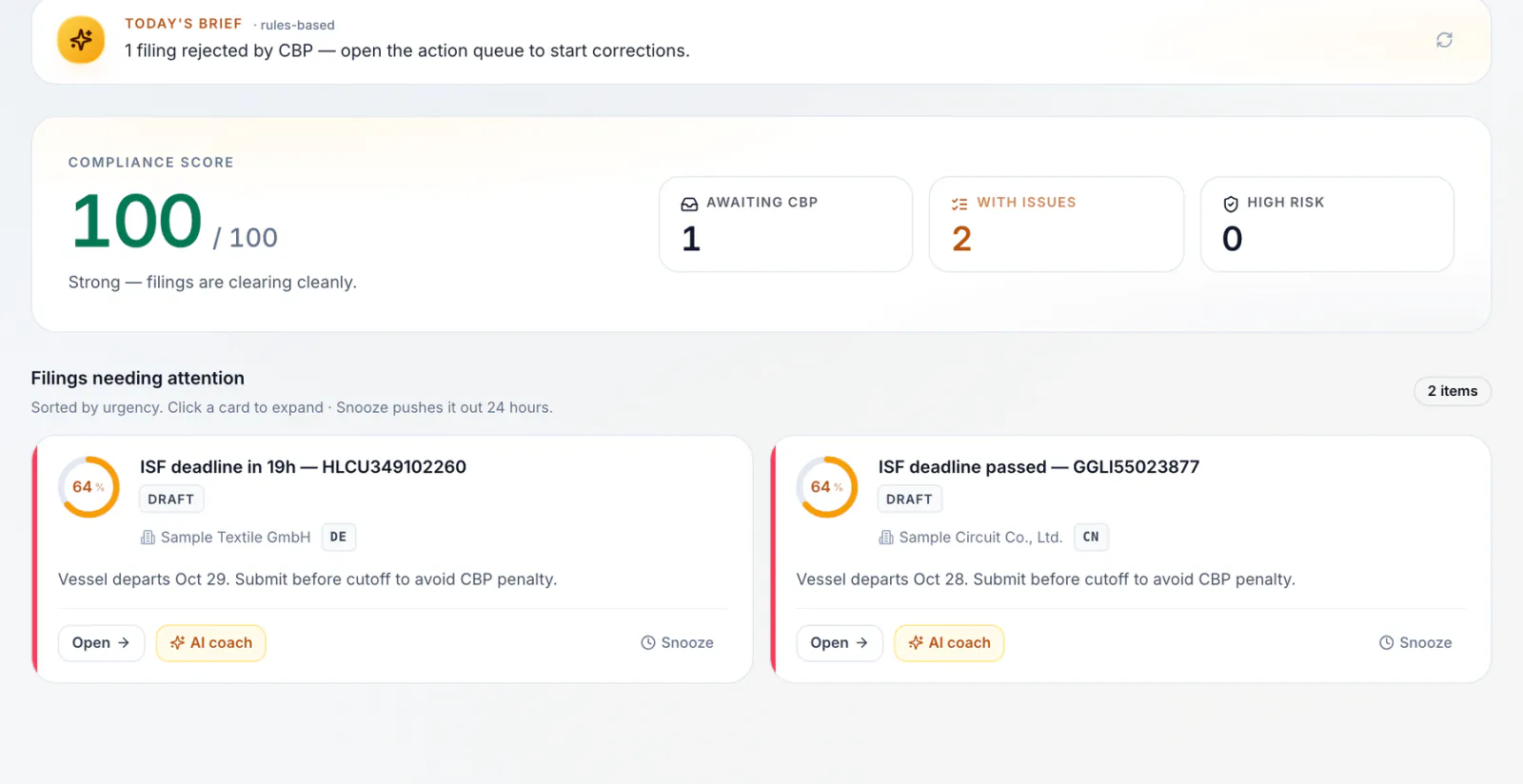
The inbox with sample data. Each ISF deadline is 24 hours before lading (19 CFR 149.2(b)).
An inbox for US customs, not another dashboard
The inbox ranks itself.
Open work across ISF, entry and liquidation sits in one list, ordered by urgency. Each ISF has a deadline 24 hours before lading, and you get alerts at 72, 48 and 24 hours before it.
CBP's response shows on each filing, so you can see what was accepted, what was rejected and what is still waiting.
72 · 48 · 24 h
ISF alerts before the deadline
314 days
Each accepted entry tracked to liquidation, with the 300-day PSC deadline in the inbox
Pre-filing checks
Catch it before CBP does.
Every draft runs through rule-based checks before you can submit it. Want a second read? Run an AI review on any draft. If CBP still rejects the filing, the error comes back in plain English with numbered steps to fix it.
The flags around the filing
- New ADD/CVD orders pulled from the Federal Register daily
- Possible UFLPA exposure flagged, plus the agencies (FDA, USDA-APHIS, EPA, FCC) that may own an HTS code
- HTS code suggestions with alternatives and the reasoning behind them
MyCargoLens flags and explains. You or your broker make the call.
What gets checked before you submit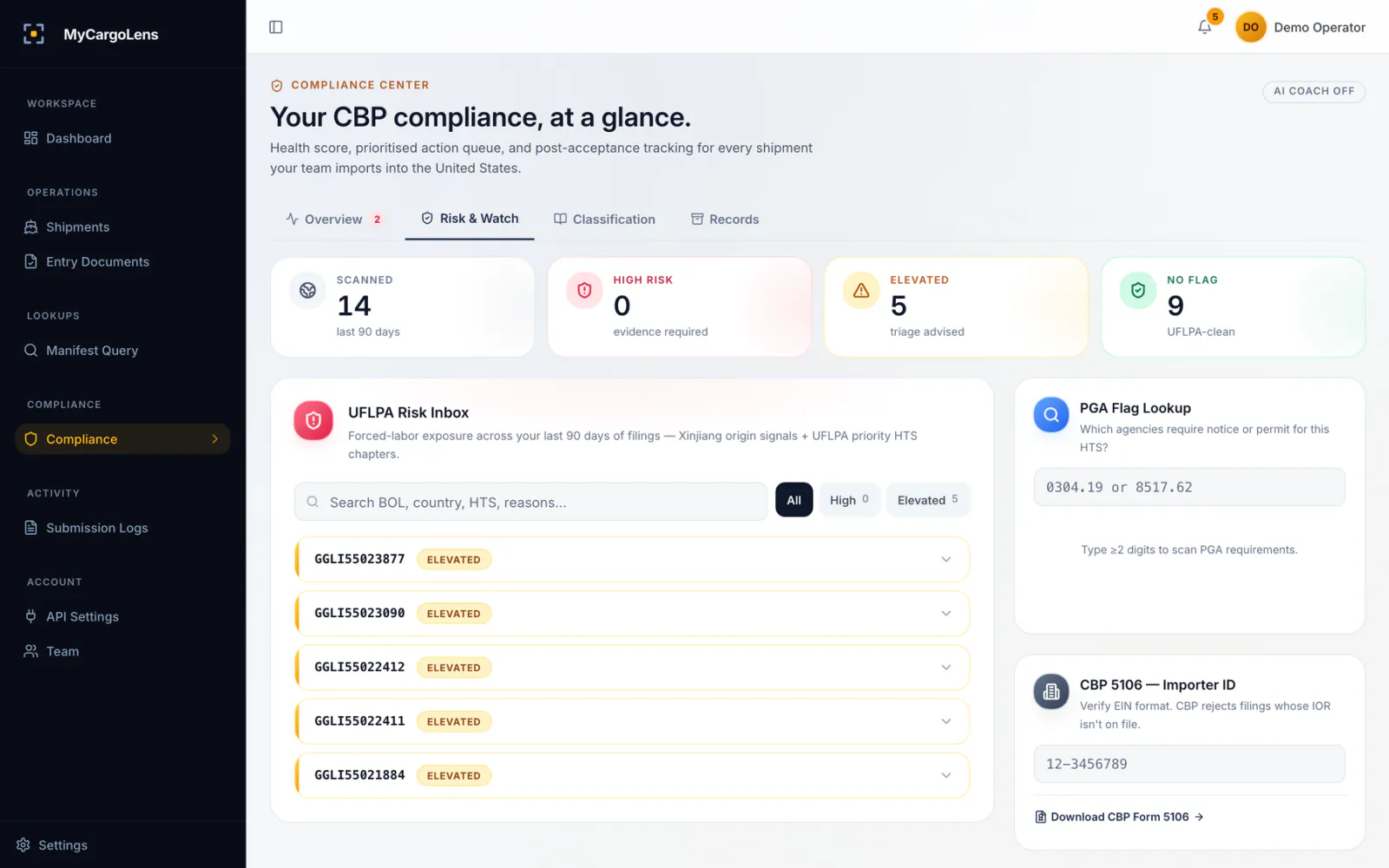
Audit trail
See who changed what, and what CBP sent back.
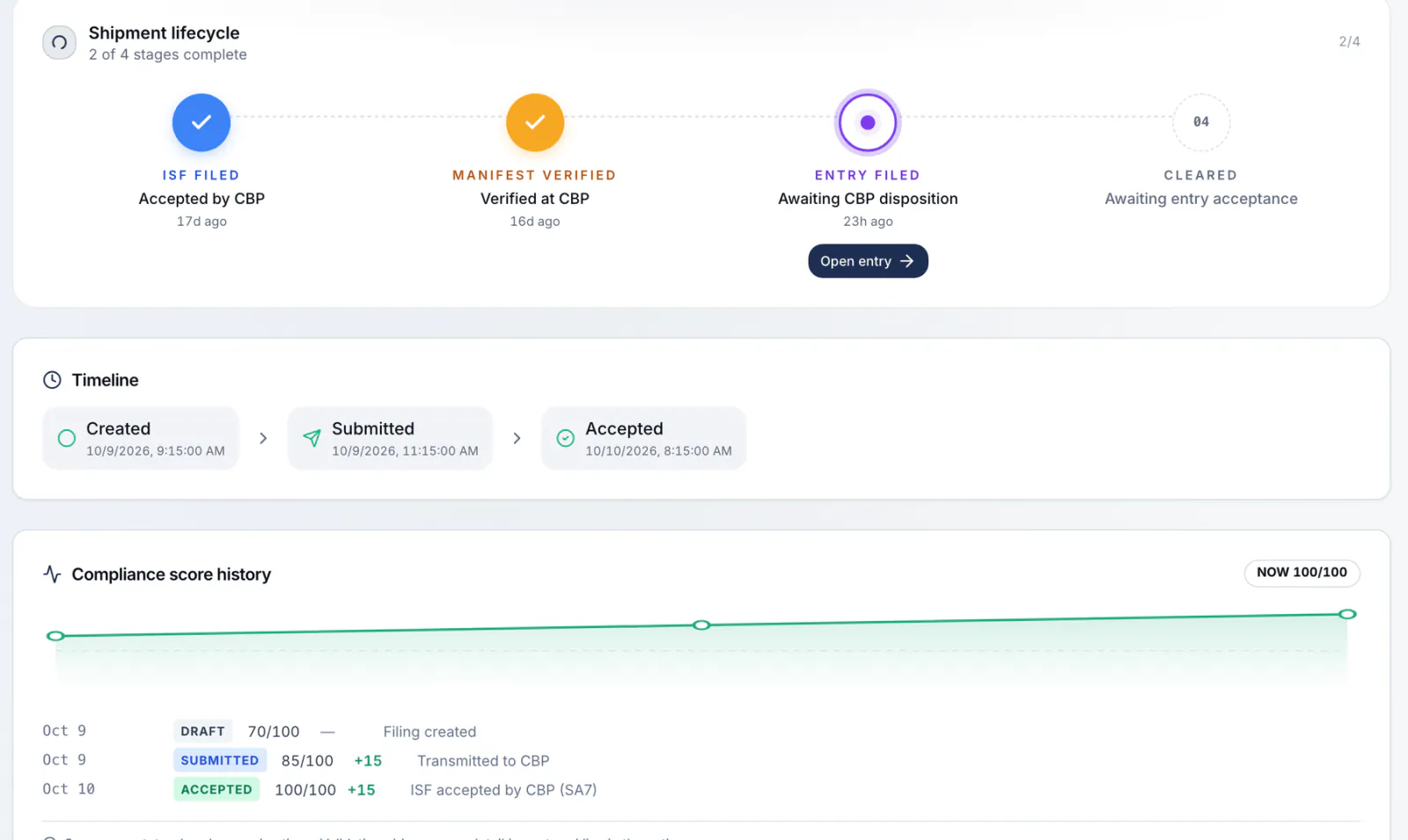
Each filing keeps its own history: who edited it, who submitted it, and every message to and from CBP, with times. Your team works under four roles with MFA, and the full audit trail exports to CSV.
Pricing
The ISF price is on the website.
ISF is $45 per accepted ISF, with no monthly fee. Customs entry is priced on a call, so talk to us.
ISF Filing
$45
per accepted ISF
Customs entry
Talk to us
Priced on a call
Filing at volume
On request
NVOCCs, forwarders and brokers
- You're charged when CBP accepts the ISF.
- Rejected filings and amendments aren't charged.
- Drafts and manifest queries are free.
Filing for others at volume? NVOCCs, forwarders and brokers get volume pricing on request, agreed in writing. Same rule: charged only when CBP accepts.
Talk to us about volume pricingWhich of these sounds like you?
Importers
Check every ISF and entry you file before CBP does, from ISF to liquidation.
For importersNVOCCs and forwarders
Every house bill on a deadline clock, filed from your TMS or in bulk from templates.
For NVOCCs and forwardersDevelopers
File ISF and entries from your own system. REST or XML in, signed webhooks out.
API and webhooksLicensed customs brokers
A ranked queue and plain-English rejections, so your team reviews instead of retypes. Ask about a pilot.
Talk to us about a pilot
MyCargoLens is software for importers, forwarders, NVOCCs and brokers. We are not a licensed customs broker.
For your systems
Your TMS can file through the API.
The public REST API takes JSON or XML. Create, submit and read ISFs and entries with scoped, revocable keys, and get status back as HMAC-signed webhooks.
# 1. create an ISF draft from your TMS
POST /api/public/v1/shipments
Authorization: Bearer mcl_live_…

# 2. submit it (same checks as the app)
POST /api/public/v1/shipments/{id}/submit

# 3. status comes back, HMAC-SHA256 signed
webhook filing.accepted
X-MCL-Event: filing.accepted
X-MCL-Signature: sha256=9f2c…e41a
{ "event": "filing.accepted", "createdAt": "…", "data": { … } }
filing.submitted · filing.accepted · filing.rejected · entry.sent · entry.accepted · entry.rejected
Straight answers.
MyCargoLens files them with CBP for you. You review and submit each one from your account.
No. MyCargoLens is software for importers, forwarders, NVOCCs and brokers. You or your broker stay in charge of advice and classification decisions.
ISF-10, ISF-5, entry summaries (7501) and cargo release (3461), plus manifest (MBOL) queries. In-bond (7512), FTZ, drawback and AES aren't available today, and we don't sell ISF bonds.
The importer of record, whoever transmits the filing. That's why it helps to see and check every ISF and entry you file before it goes to CBP.
ISF is $45 per accepted ISF, with no monthly fee. You're charged only when CBP accepts. For customs entry, talk to us on a demo. NVOCCs, forwarders and brokers filing at volume get volume pricing on request.
We're early, and we'd rather say so. You see and check every filing before it goes, and ISF is charged only when CBP accepts it, with no monthly fee.
In 20 minutes we walk through how you file today, show the parts that matter for your shipments in a demo account and tell you what it would cost. If it fits, we set up your team.
Book a demo
See how your shipments would run through the inbox.
Book a 20-minute demo. We'll walk through how you file today, show you the parts that matter and tell you what it costs.
ISF is $45, charged only when CBP accepts. No monthly fee.
Software, not a customs broker